
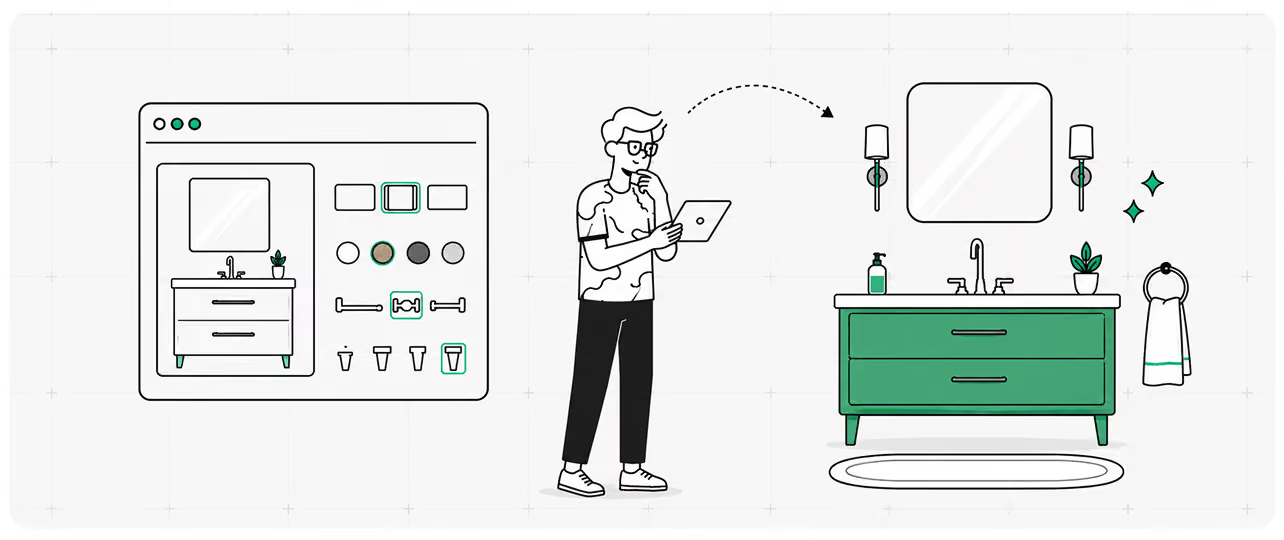
For furniture manufacturers with deep, complex product lines, a web-based configurator is often framed as a digital marketing upgrade. The more accurate framing is operational infrastructure. When built around your actual manufacturing logic it reduces order errors, shortens quoting cycles, strengthens dealer loyalty, and creates compounding margin benefits that extend well beyond the showroom. A system built for you is one that carefully considers your rules, your dependencies, and your dealer workflows amongst other factors unique to your operation. This post traces that chain of causality and is honest about where it breaks down.
The gap most manufacturers accept
A furniture manufacturer with a sophisticated product line faces a structural challenge that resists easy solutions. The range of what they make (sizes, finishes, hardware options, material combinations) often runs into the hundreds of thousands of configurations per product family. Photographing even a fraction of that catalog is cost-prohibitive. Expecting dealers to carry that knowledge confidently in their heads is unrealistic. And sending a prospect away to request a quote introduces the kind of friction that kills sales too early in the process.
Most manufacturers accept some version of this as the cost of selling complex goods. The interesting question is what changes when they don't.
A web-based configurator, at its most basic, lets a dealer or customer visualize a product in real time, with each selection updating the image as they go. That part is relatively well understood. What is less often explored is what happens downstream — to dealer behavior, to order quality, and ultimately to the economics of the operation.

Why dealer adoption is the real test
The only configurators that work are those that dealers use daily and with absolute confidence. This sounds obvious, but it is where most off-the-shelf solutions fail in practice and it is the benchmark against which any serious investment should be measured.
Timberline is a family-owned bathroom furniture manufacturer that had spent close to twenty years building a deep, made-to-order vanity range. Their dealers knew the catalog, but were selling it through printed brochures and item numbers. The homeowner sitting across from them in the showroom was expected to hold dozens of combinations in their mind and make a confident decision.
When we built the Timberline configurator, the test we kept returning to was simple: could someone open it for the first time and just start building? The answer mattered commercially. A tool that feels intuitive earns daily use, while a tool that requires training gets opened reluctantly and closed early.
The result exceeded what we and Timberline had anticipated. More than 80% of Timberline's dealers adopted the configurator, and the industry feedback was immediate: this was the best in the category. Dealers opened the tool and understood it without instruction, because the flow mirrored the natural way someone thinks about specifying a vanity, starting with size , then color, then hardware. Each selection updated the image in real time. The conversation in the showroom changed. "Is this what you're picturing?"
William Scott, Timberline's General Manager, captured the market reaction as follows:
"Customers [showroom sales staff] got the impression that we had all these new options. They'd say, 'Wow, you've got so many more things now.' But we hadn't changed anything. It was the same range. They could just finally see its true potential."
No new products had been launched and there had been no catalog expansion. The range was identical to the day before. But once the barrier between what existed and what customers could visualize came down, combinations that had been buried in a printed catalog came to life. Dealers could explore further and customers chose with conviction, because guesswork had been replaced with clear, visual certainty.
What 'built for your logic' means
The distinction between an off-the-shelf configurator and a custom-built solution is often framed technically. The more useful framing is an operational one.
A standard plugin handles a fixed logic structure. Your product, however, has dependencies. A particular handle style may only be compatible with certain drawer fronts. A vanity above a certain width changes its internal configuration. These rules live in the heads of your most experienced salespeople and on spec sheets that dealers rarely read in full. A configurator built for your business codifies those rules into the interface itself. The dealer cannot make a technically invalid selection, because the tool doesn't offer it.
Under the hood, the Timberline configurator manages over 50,000 layered images to render every possible combination in real time, without any perceptible lag. That technical architecture is based on a smart layering approach, and it’s this infrastructure that allows millions of visual combinations to load as fast as a dealer can click, across a tablet on the showroom floor or a laptop at someone's kitchen table. The engineering is invisible to the user, which is precisely the point.
This is where the downstream benefits begin to compound. When a dealer builds a configuration and generates an order, that order reflects real manufacturing logic. The back-and-forth between sales and production shrinks. The factory receives a specification that maps directly to how the product is actually built, rather than a best-effort interpretation from the showroom floor. Fewer items are returned because the configurator filters incompatible options before the order is ever placed. What a customer sees on screen is what arrives at their door.
The right configurator changes everything
The investment case for a configurator is often made at the surface level — dealers like it, engagement improves. The stronger argument runs deeper, and it is worth tracing clearly.
Dealer adoption rises when the tool mirrors how they already think. Dealers who use the configurator confidently show more of the product range, because they can visualize combinations that would otherwise require prior experience or educated guesswork:
- More of the catalog gets presented to more clients.
- Configuration accuracy increases because the dependency rules are built in.
- Accurate configurations generate cleaner orders.
- Cleaner orders reduce factory friction.
- Reduced factory friction improves margin on each unit.
- Improved margins create reinvestment capacity (in new product development, in the tool itself, in the dealer relationship, etc.).

The Timberline results reflect this chain in practice. The top six most visited pages on their website are now all configurator screens. The quoting process has fundamentally changed: they're now doing fewer quotes for more revenue, without adding headcount to manage the volume. Timberline’s growth is not all attributable to the configurator alone — it is a growing business in its own right — but the pattern is clear.
There is also an effect that most manufacturers don't anticipate: the configurator starts to shape product development.
At Timberline, new collections are now conceived with the configurator in mind from the start — how each new option will interact with existing combinations, how it will render, how it will sit within the logic structure. The tool changed how they sell first, and now it has started to change what they design.
A note on full utilization
Ease of use is a double-edged quality. Because the Timberline configurator felt immediately natural, a significant number of dealers assumed they had already found everything it could do and skipped formal training as a result. Some went months before discovering that the tool generated co-branded PDF tear sheets carrying both their logo and Timberline's. Others misread the saved configuration code as a standard product item number rather than a retrievable specification.
Neither gap undermined the outcome, but both illustrate an important principle: intuitive entry does not always lead to full utilization. The manufacturers who extract the most value from a configurator build are those who invest equally in onboarding, making sure the full capability of the tool is actually being used. At Kalon, we’re also taking these user behaviors as learning opportunities for future UI improvements.
What the engagement data reflects
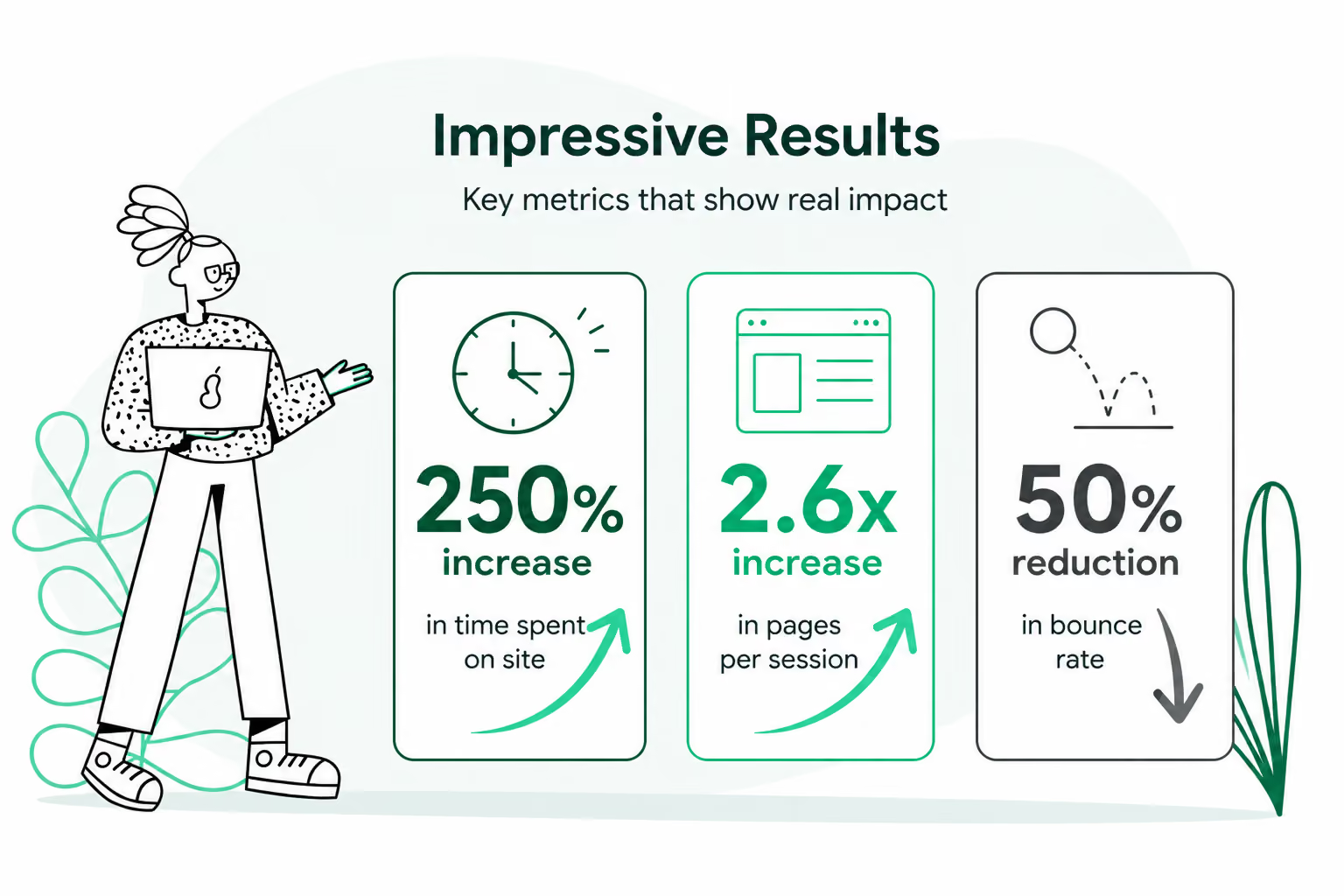
Across the manufacturers we work with, the engagement shift that follows a well-built configurator launch is consistent. The Furniture Guild, a high-end furniture manufacturer we built a configurator for, saw a 250% increase in time spent on site, a 2.6x increase in pages per session, and a 50% reduction in bounce rate after launch.
These are engagement metrics, but they are also a proxy for something more commercially significant: dealers and customers are exploring the full catalog rather than defaulting to what they already know. They are considering more combinations, spending more time with the brand, and arriving at purchase decisions with far greater confidence. A customer who has watched their piece take shape on screen, click by click, is a customer who knows exactly what they are ordering. That certainty reduces returns and post-purchase dissatisfaction in ways that are genuinely difficult to achieve through any other channel.
Who this is for and who it isn't
A custom furniture configurator is a meaningful investment. It is best suited to manufacturers whose product lines are genuinely complex. Multiple configuration dimensions, compatibility dependencies, and finish or material combinations that cannot practically be photographed in full. Manufacturers with a small, relatively static SKU set will see narrower returns, and a simpler solution is likely the more honest recommendation for them.
It is also worth being direct about what ongoing commitment looks like. Product lines evolve. New options get added, discontinued finishes need to be retired, and dependency rules need updating as ranges change. The manufacturers who see the deepest long-term benefit are those who treat the configurator as a living system, not a completed project. That requires a working relationship with the team who built it — which is why we structure our engagements as long-term partnerships from day one.
A different way to think about the investment
The most useful question when evaluating a furniture configurator is this: what is the current cost of the gap between what we make and what our dealers can confidently sell?
That cost tends to be distributed and invisible — it lives in lost showroom moments, in order errors, in factory rework, in dealer preference for a competitor who is simply easier to work with. A well-built configurator addresses several of those costs at once, and the compounding benefit of getting it right extends well beyond any single sales season.
If you are navigating that question for your business, we would be glad to work through it together. There is no generic answer, and the most useful conversation always starts with understanding your catalog, your dealer network, and where the friction actually lives.



.avif)

.avif)